
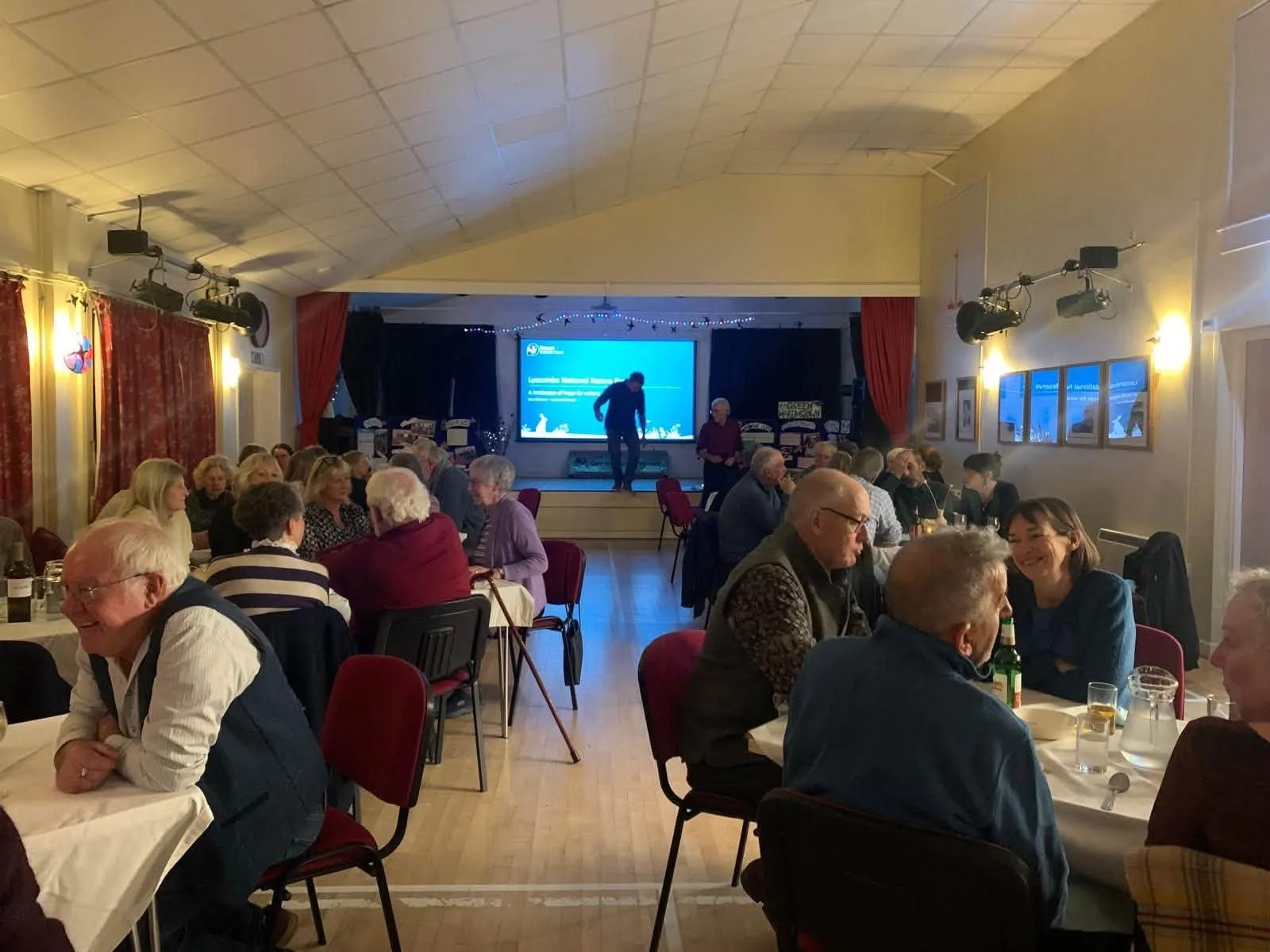
What a lovely evening! Wonderful music from Wendy, Gill and Clare, delicious locally sourced, home-cooked food, a great turnout and plenty of good company.
A huge thank you to Ben Atkinson from Dorset Wildlife Trust for his informative and inspiring talk. We hope to organise a group visit to Lyscombe in the spring, so watch this space!
Special thanks to Russ and Annette for running the bar, Sally and Mike Bradshaw for all their help, our brilliant kitchen team and everyone who stayed behind to help clear up. It really was a great team effort.
We’d also love to hear your feedback. Please do get in touch and tell us about your experience of the evening.
Thank you to everyone who came along and supported us.
The GM Core Group
Nature Recovery at Lyscombe – Our Annual Supper Evening
Write up by Charlotte Beare
At our November supper evening, we welcomed Ben Atkinson, Dorset Wildlife Trust's ranger at Lyscombe National Nature Reserve, who gave us a fascinating insight into the practical work involved in restoring biodiversity.
Situated just 13 miles from Martinstown, Lyscombe covers 826 acres and was acquired by Dorset Wildlife Trust in March 2024, becoming its largest nature reserve. The site encompasses nationally important chalk grassland, wildflower meadows, ancient woodland, archaeological features and the headwaters of the Little Piddle chalk stream.
Ben explained how traditional conservation techniques are being combined with rewilding, allowing natural processes to shape the landscape.
It was particularly interesting to learn how the different grazing habits of English Longhorn cattle and Konik ponies create greater complexity and biodiversity. Cattle tear out clumps of vegetation, creating opportunities for wildflowers to establish, whilst ponies graze more closely, maintaining the short turf favoured by many chalk grassland species. Cattle also browse trees and shrubs and push through brambles, creating small pockets of disturbed ground that benefit birds and insects.
The results of conservation grazing are already evident. Adonis blue and marsh fritillary butterflies have returned after several years of absence, and hundreds of cowslips are flourishing once again.
Around 50 hectares of wildflower meadows, established by the previous landowners over 20 years ago, now provide a valuable source of seed for restoring and connecting habitats elsewhere on the reserve.
Another memorable example was the creation of large brush piles to introduce structure and interest into otherwise open fields. Ben described how, in just 20 minutes, he observed great tits, blue tits, dunnocks, robins, blackbirds, bullfinches and yellowhammers flitting in and out of these piles. Visiting birds deposit seeds, whilst the branches protect emerging seedlings from grazing animals, allowing shrubs and eventually trees to become established naturally.
A significant part of the project involves restoring the Little Piddle. Sections of the stream have been freed from concrete, whilst leaky dams are helping to slow water flow and reconnect the stream with its natural floodplain, with the potential to create several hectares of rare, calcium-rich wetland habitat.
The talk highlighted the importance of creating bigger, better and more connected habitats, offering plenty of food for thought as Green Martinstown looks towards developing its own community land project.
Many thanks to Ben for sharing his knowledge, experience and observations. Lyscombe is open to the public, and we would encourage anyone interested in nature recovery to visit.
Five key learnings from Ben’s talk
1. Different grazing animals create greater biodiversity.
Cattle and ponies graze in different ways, creating varied vegetation heights and opportunities for wildflowers, insects and birds.
2. Small interventions can make an immediate difference.
Brush piles provide shelter, attract numerous bird species and encourage the natural regeneration of trees and shrubs.
3. Wildflowers thrive in nutrient-poor soils.
Removing hay reduces soil fertility, whilst yellow rattle suppresses vigorous grasses, allowing other wildflowers to establish.
4. Rivers need space to behave naturally.
Leaky dams slow water flow, help reconnect streams with their floodplains and encourage the formation of wetland habitats.
5. Nature needs bigger, better and more joined-up habitats.
Connecting existing wildlife-rich areas allows species to spread and establish new populations, creating a more diverse and resilient landscape.
